The Project
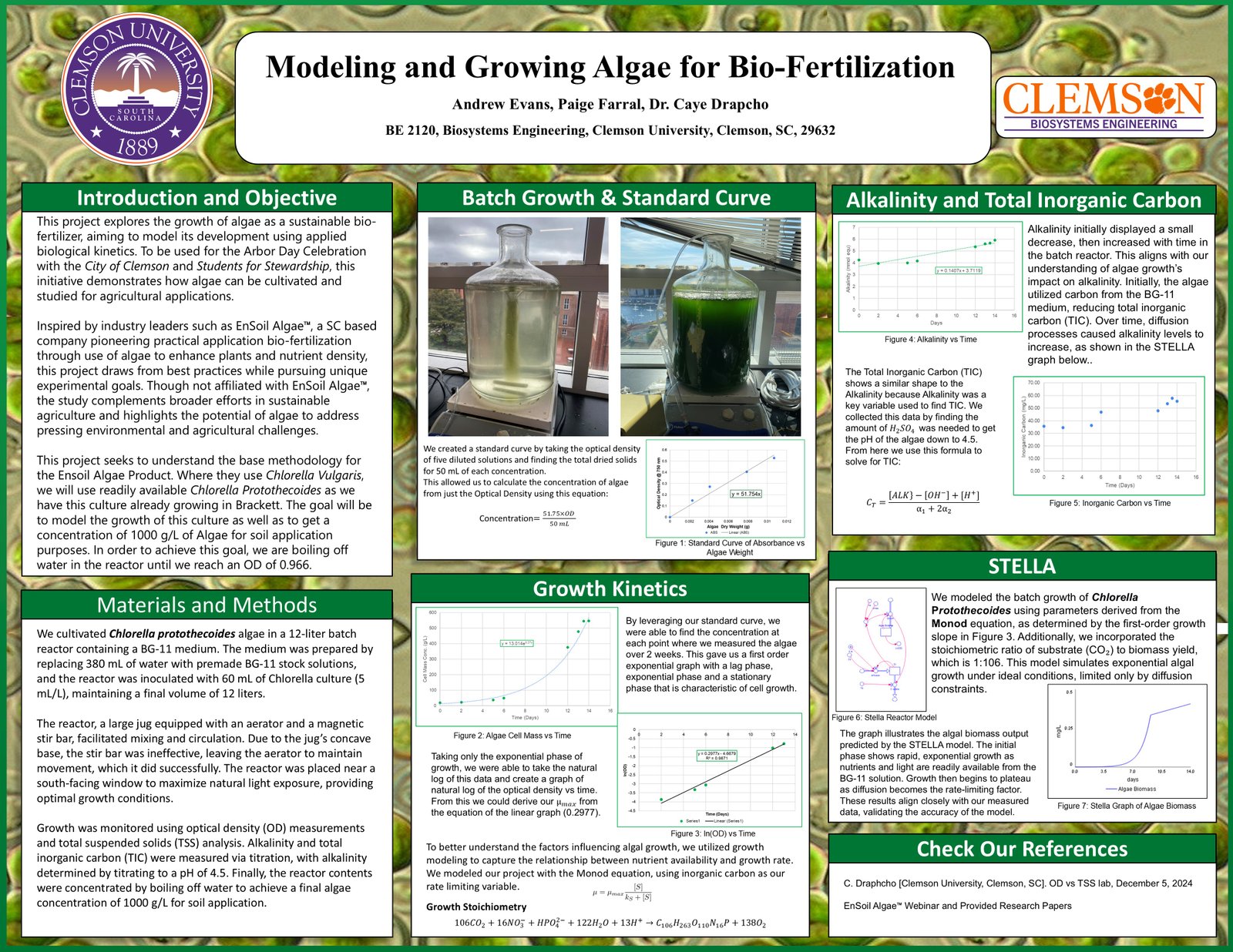
Synthetic fertilizers have enabled modern agriculture, but at significant cost — nutrient runoff, soil acidification, groundwater pollution, and carbon emissions from production. This project investigated algae as an alternative: a biological system that captures nitrogen, grows on wastewater nutrients, and can be applied directly to soil as a biofertilizer.
The team grew algae in batch reactor setups, tracked growth kinetics, and used the STELLA systems modeling environment to model growth curves and optimize conditions. The goal was to evaluate practical feasibility as a local, low-input fertilizer alternative — particularly relevant for a university-city partnership context where algae could be grown on treated wastewater effluent.
The project was presented at Clemson's Arbor Day celebration — a public-facing audience, not just academic peers. That matters. Making technical work legible to community stakeholders is part of the job.
Technical Approach: Biological Kinetics
Algae growth was modeled using the Monod equation — a classic kinetic framework for microbial growth as a function of limiting substrate concentration. STELLA systems modeling was used to simulate batch reactor dynamics, predict optimal harvest timing, and evaluate nitrogen uptake rates under different light and nutrient conditions.
Project Info
Interested in the data or methodology? Get in touch.