HUNNICUTT FOOD FOREST · STUDENTS FOR STEWARDSHIP · CLEMSON, SC
A food forest, for starters — planted at the headwaters of Hunnicutt Creek by students who believe you can feed a community and heal a watershed at the same time. Come see. Better yet, come dig.
WHO WE ARE
We're a student club at Clemson that has already outlived a complete turnover — the founding crew moved on, and the food forest kept right on growing. That's the thing about planting something real: it makes the club bigger than any one of us.
And this last year has been the best one yet. We work side by side with the Agronomy Club, the Biosystems Engineering department has been behind us the whole way, and everywhere we turn there's a new partnership ready to form — from the campus greenhouses to the restoration agriculture farm down at the Clemson bottoms. People from every background and belief show up, work next to each other, and leave with dirt on their boots and new friends.
That's the whole secret. Stewardship is something nearly everyone can get behind — and college is for making memories. We'd love for you to join us as we cultivate Clemson.
START HERE
Stewardship Sundays run nearly every week — show up, grab gloves, and someone will hand you something alive to put in the ground. Every semester we throw Cultivate Clemson, our open festival at the food forest with partners from across the Upstate. No dues, no experience needed, no commitment. Just come once.
HOW WE THINK
Here's what we've seen firsthand at the food forest: a degraded water system can zap the life out of a place. And the reverse is just as true — when water gets to slow down, soak in, and stay, biodiversity flourishes. Living soil holds the water. The water feeds more life. More life holds more water.
It's a positive feedback loop, and it's the most hopeful thing we know. So that's what we're trying to be at Clemson: the positive feedback loop of biodiversity. Every swale we dig, every root we sink, every person who joins a workday makes the loop stronger.
The loop gets stronger every time someone joins it.
ON THE GROUND
The food forest is the thesis with its sleeves rolled up: grow real food and rebuild a living system, on the same ground, at the same time. Native, edible, medicinal, pollinator-friendly — every plant earns its place twice.
Every species we choose is evaluated against four criteria:
Prioritized species for Piedmont SC conditions and greenhouse propagation. Bold = highest success rate.
What We're Really After
Everything we plant or build comes back to three things.
A public, edible, medicinal landscape anyone can learn from and eat from — native, edible, and pollinator-friendly species chosen to actually produce food, not just decorate.
Slow the water, cool the soil, and rebuild the living sponge at the headwaters — biofilters, natural pools, deep roots, and fungi that improve water quality in Hunnicutt Creek and restart the biotic pump.
Build it shoulder-to-shoulder with clubs, neighbors, and partners — a third place where stewardship is something you practice alongside other people, not a thing you only read about.
THE LIVING MAP
The food forest keeps its own living record — a satellite map the club pins plantings, problems, and art onto, a library of every plant we've put in the ground, and a nursery ledger of what's coming next. It updates because we're out there, not because someone wrote a press release.
LIVE MAP
Satellite view of Hunnicutt — every planting, problem, and piece of art the club has pinned, as it happens.
FIELD GUIDE
Every species we've put in the ground, cataloged and searchable — the field guide to what's actually growing.
THE KIOSK
The cork board, the calendar, and the nursery ledger — one sign post for everything the club's up to.
BIGGER THAN US
In the Sahel, the Great Green Wall stretches across eleven nations — communities holding the front line with food forests and tree nurseries. In India, teams reshaped whole valleys so monsoon rain would slow, spread, and sink; wells refilled, and families stayed. Different continents, different cultures, same loop: when we design for water, biodiversity follows. When biodiversity thrives, water sticks around.
What heals a region is the same thing that healed a quarter-acre at Clemson. The scale changes. The relationship doesn't.
OUR STORY
We petitioned for a neglected patch of campus, and we got it. Our first summer brought a brutal drought that taught us more than any classroom could — and we answered it with swales, Zuni waffle gardens, and every rain-harvesting idea we could find. The ground held. The club has since survived a full changing of the guard, and the dream that started it all still stands: stream restoration through watershed-scale stewardship — clean water and healthy habitats, starting right here.
SUMMER 2024
South Carolina baked that summer under a drought so deep that rivers turned to memory and the ground split open like worn, calloused hands. At our new food forest, the insects went quiet. The birdsong stopped. We'd just planted three peach trees on our hillside, and we were about to get an education.
Tree one stood at the top of the hill. The drought had the high ground, and he was the first to fall. Tree two held on while the silence in the soil crept downhill. Tree three was our underdog — the last holdout at the bottom of the slope, closest to the creek. Two of us spent the summer hauling five-gallon buckets up from that creek to keep him alive. It was like trying to put out a house fire with a teacup.
That's when it clicked: drought isn't just dryness. It's the loss of resilience — the loss of life's ability to buffer the unexpected. When the soil goes silent, everything gets fragile. The trees, the insects, the birds. Even us.
THE NEXT SPRING
We stopped trying to rescue plants one bucket at a time and started asking why the land couldn't hold water on its own. The answer changed how we work. We shaped the ground to slow rain down and let it sink. We covered bare soil. We planted roots that feed the microbes that feed everything else.
The next year, more saplings went in the ground — and they held. Yes, the summer was gentler. But that's only part of the story. Water stays with us longer now. The plants feed the microbes, the microbes feed the roots, and every layer of the web gains a little more footing. That's what stewardship buys: not a guarantee, but resilience.
THE ONES WHO SHOWED UP
The first time we needed help, the Upstate answered. A farmer from Six Mile walked our slope and showed us how to read where water wants to go. A builder from Seneca brought a broad fork instead of a slideshow. A nonprofit in a 1913 Anderson schoolhouse showed us what it looks like to feed 75 families a week from two acres. Mentors, donors, campus crews — this place is as much theirs as ours.
Walked our slope in the first fall and led the keyline design session that still shapes how we plan the site.
Showed up with a broad fork instead of a slideshow and taught us to read the land before designing it.
Feed 75–100 families a week from two acres in a 1913 Anderson schoolhouse — proof of what soil and community can do.
Somewhere near you, a patch of land is asking for a better conversation with water. Your balcony planter counts. The median strip outside work counts. The neglected corner of campus definitely counts — that's how this whole thing started.
You don't need a degree. You don't even need a plan. You need a Saturday and a pair of boots.
or just wander the map of what we've planted →
HOPE, WITH A SHOVEL.
Find Us
Located on East Campus near Kite Hill, off Newman Road — at the very headwaters of Hunnicutt Creek on Clemson University's campus.
What We've Done
Click a semester to expand. Built from Instagram posts, newsletter issues, and site records — add yours at ace4@clemson.edu.
In the Field
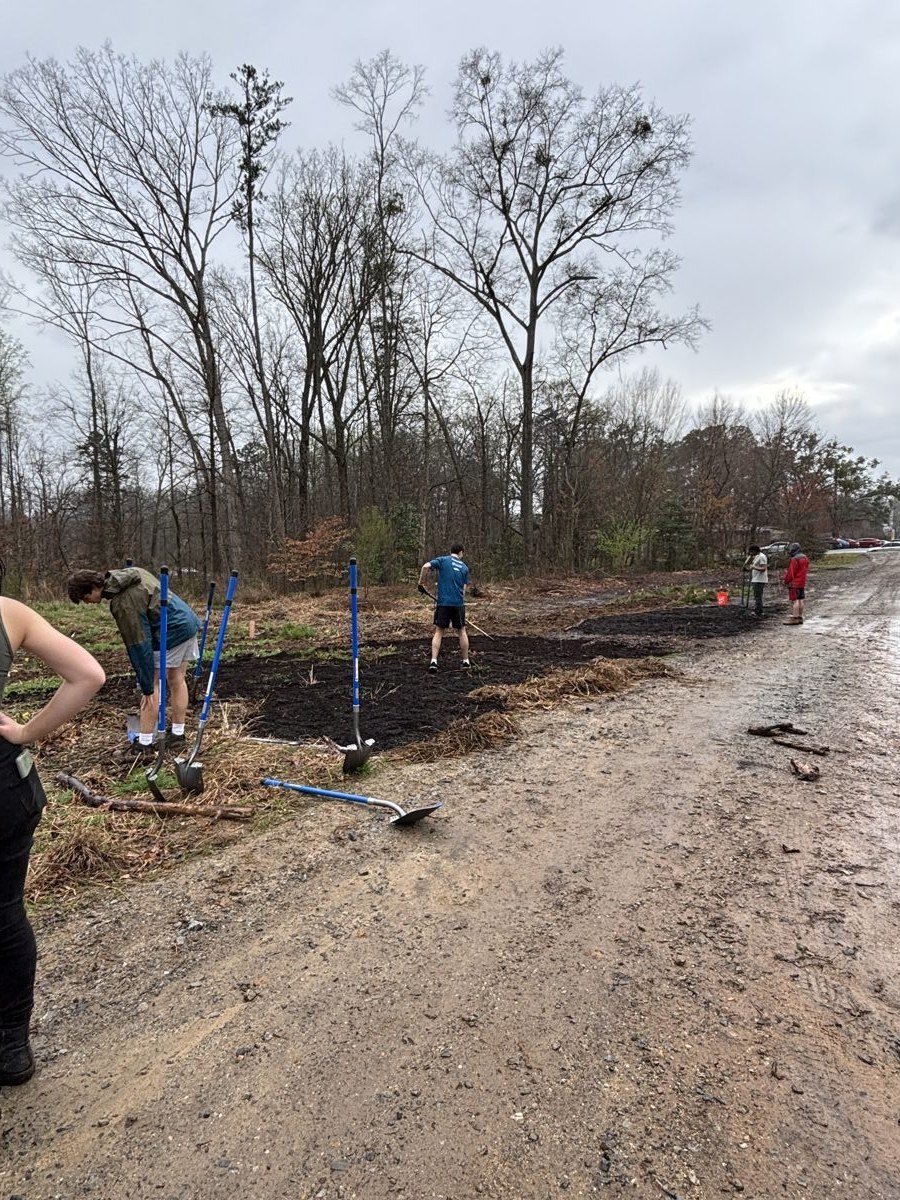
No stock photos. Every image here is a day at Hunnicutt — planning, planting, propagating.
MENTORS · PARTNERS · PRESS
The Hunnicutt Food Forest didn't get built from YouTube videos. It got built because real practitioners showed up, shared tools, and poured into students. This page is for them.
Who Taught Us
Every one of these people showed up to Hunnicutt or invited us into their world. Click any name to learn more.
Zephaniah Smith co-founded The Cleo Bailey Experiment in 2020 with his wife Whitney — in the middle of a pandemic, in a food desert on Anderson's East Side, in a 1913 schoolhouse on two acres of land. That's the kind of audacity that actually changes things.
The Cleo Bailey Experiment (CBE) now runs the Oasis Garden — 14 raised beds plus open rows growing blackberries, tomatoes, squash, cucumbers, melons, pumpkins, greens, and herbs — and serves approximately 75 to 100 families a week through a food bank partnership with Anderson First Seventh Day Adventist. The mission: break the cycle of generational poverty through research, support, and education. Zeph puts it plainly: "We're getting people's hands back in the soil."
Zeph's relationship with S4S is one of the most formative partnerships we have. His Jan 24, 2025 kickoff event launched our year with intention, and his philosophy — that strong communities are built through agriculture and shared labor, not through programs — is the same philosophy we're trying to carry at Hunnicutt. CBE isn't a boutique farm. It's a real place where people show up.
Advisors, Donors & Institutional Support
Lowe's donated the first major round of plants — 3 peach trees, 4 blueberry bushes, 3 raspberry bushes, and a grapevine. This single donation made Spring 2025's planting possible and established the first orchard zone at Hunnicutt. Big impact, simply given.
Campus partner for site access, tree corridor coordination along Newman Road, and collaboration on the East Campus green infrastructure vision.
SCNPS coordinates the spring plant sale that S4S uses to source annuals, medicinals, and native species. They published the first major press feature on Hunnicutt — "Cultivating Land Ethics at Clemson" — and connected us to the statewide native plant community. Rick Huffman co-founded SCNPS in 1996.
Jon Fritz — landscape designer and Clemson landscape architecture graduate — helped design the Hunnicutt Food Forest layout and introduced S4S to the 12 Cues to Care framework that shapes how we think about site legibility and ecological design. His practice, Bluestem Landscape Design LLC in Seneca, SC, teaches eco-friendly horticulture, native plant selection, and right-plant-right-place design.
Named for Schizachyrium scoparium — little bluestem, the native grass that anchors so much of what we plant at Hunnicutt.
On Campus
Students for Stewardship draws on the whole campus — from agronomy to carpentry to neuroscience.
Carson Wargo coordinated the food forest plant list — trees, understory shrubs, flowers, and grasses prioritized for Piedmont conditions and propagation viability. The club's greenhouse is a key pipeline for native and pollinator-friendly species.
Built structures at the site — and slated for the Purple Martin birdhouse builds and bench installation in Spring 2026. Hands-on making is part of what the food forest teaches.
Overlapping mission and membership — supporting native species selection, plant ID workshops, and the SCNPS spring sale coordination pipeline.
Our GIS and engineering model. CEDC's workstation setup (Nvidia RTX A6000, local data pipeline) is the direct inspiration for S4S's planned digital twin workstation buildout.
Home of Mapping TigerTown — the 3D campus basemap where the Hunnicutt digital twin will live. Guidance from the Geospatial Center informs the Phase 2 expansion of stewardship layers across campus.
Anaston Porter and the Carolina Clear program connect S4S to Clemson's broader stormwater and water quality network — linking the food forest's headwaters work to the university's official water management goals.
In the News
Our work has been recognized by sustainability organizations, national agriculture networks, and Clemson's own student press.
The SCNPS featured our work blending native plantings with regenerative design to restore Clemson's most ecologically sensitive watershed area.
Read article →The National Sustainable Agriculture Information Service highlighted HFF as a national model for student-led ecological restoration and food forest development.
Read article →Clemson's student paper covered the founding of S4S and the club's vision for regenerative food production on campus.
Read article →Places We Love
The food forest doesn't exist in isolation. These are the places in our area that are doing the work — markets, farms, fermenters, and community hubs worth knowing about.
Anderson, SC · 1003 East Whitner St
Zeph and Whitney Smith's community farm and nonprofit, rooted in a 1913 schoolhouse on Anderson's East Side. The Oasis Garden serves 75–100 families weekly. A living model of what it looks like to build community through soil.
Seneca, SC · Treehouse Internatural
Scott Bunn's school of practical ecological building — trades, homesteading, and sustainable construction taught through doing. If you want to learn how to build something that lasts, this is the place.
Six Mile, SC · Delivers to Clemson area
Concetta Cone's all-natural, no-till farm in Six Mile. CSA boxes of fresh vegetables, pasture-raised eggs, and hand-crafted dried flower bouquets, delivered to Clemson, Central, Pendleton, and beyond. Certified SC Grown.
Pendleton, SC · Local food + fermentation
David Thornton's farmhouse brewery and winery in Pendleton — craft ales, ciders, and meads rooted in local ingredients and traditional fermentation methods. Part of the wider Upstate food economy S4S is trying to connect and amplify.
Upstate SC · Local food market
A local food and farm market serving the Upstate — where farmers, producers, and eaters connect in the Clemson area. Growing food is only part of the work; connecting growers to tables is where regenerative agriculture becomes an economy.
Regenerate Upstate
We ran a newsletter called Regenerate Upstate on Beehiiv — field notes, partner spotlights, and stories from 2024. Three issues, all still up. Worth a read.
Cleo Bailey kickoff event, fig propagation push, and a spotlight on Carolina Bauernhaus in Pendleton. The newsletter that set the tone for 2025.
25+ mushroom logs inoculated with Dr. Kerrigan, Farm Girl Deliveries volunteer day, Tiger Valley Market spotlight, and stewardship days in November.
Back-to-school at Issaqueena Lake, Scott Bunn's broad fork demo, Concetta's keyline design session, and an invitation to the October stewardship day.
Presentations · Proposals · Documents
Presentations, proposals, and founding documents from Students for Stewardship — the paper trail of an idea taking root.
The Paper Trail
Every proposal, field record, and reference document — organized into three groups. Click any group to open it.
The club's core outreach deck — stewardship definition, Pillars of Planting, the "Stewardship connects to..." framework, and the annotated 2025 site plan. Used for faculty meetings, partner pitches, and new member orientations.
The case for connecting HFF to the Green Crescent Trail and Clemson's city-wide green infrastructure. Aligns with the CU Long-Range Framework Plan and City Comprehensive Plan. HFF sits at the junction of the Botanical Gardens, Pecan Grove, and Gateway Park.
S4S's mission statement document and Spring 2026 workplan. Introduces the "Cues to Care" design principle — visible, legible site features that communicate intention. Outlines the corridor fork concept for East Campus green infrastructure.
Design documents for the Newman Road roadside tree line — one canopy tree + a guild ring of 3–5 perennial support plants per module, mulched and labeled along the estimated 1,000-foot frontage.
The full professional landscape plan for the HFF site — site zones, planting areas, circulation, features, and the spatial layout the digital twin is built to represent. The authoritative spatial document for the site.
Carson Wargo's greenhouse-prioritized plant list for the food forest — trees, understory shrubs, flowers, and grasses chosen for Piedmont SC conditions and propagation viability, with the highest-success species flagged. The propagation playbook behind what we plant.
The 2018 civil engineering construction bid set for the Hunnicutt Creek Reach 1 restoration — forebay wet pond, boulder steps, bank stabilization, and grading drawings prepared by Land Planning Associates for Clemson University. The formal engineering foundation our work builds on top of.
Construction design drawings for the living-wall bank stabilization along Hunnicutt Creek Reach 1 — GreenLoxx non-MSE reinforced living walls, boulder steps, and Filtrexx bank stabilization detailed against the creek centerline. The structural side of restoring the bank with living material.
Data
87 plants × 42 attributes — every species at Hunnicutt, catalogued with canopy layer, guild roles, nitrogen fixer status, mycorrhizal type, host species, edible parts, watershed function, and more.
Built by the club in Spring 2026 using openpyxl + Python and verified against the NC State Extension Plant Toolbox. The foundation of the HFF digital twin. Available as an Excel workbook with four sheets: Species Database, Hunnicutt Field Instances, Field Dropdowns, and Reference Links.
Request the Database"An action-based club needs record-keeping that can keep up — and eventually a stewardship 'gaming' layer that helps people learn, design, and improve land responsibly."
— Digital Twin Vision, 2026