Presentations, proposals and field records.
Every proposal, field record and reference document we have used, in three groups. Each one opens as a PDF.
The paper trail
Plans & proposals
Outreach, site proposals and planning documents.
S4S Outreach Presentation
The club's core outreach deck: the definition of stewardship, the Pillars of Planting, and the annotated 2025 site plan.
Open the PDF →Green Corridor Proposal
The case for connecting the food forest to the Green Crescent Trail and Clemson's green infrastructure.
Open the PDF →East Campus White Paper
The club's founding white paper and Spring 2026 workplan, including the Cues to Care design principle.
Open the PDF →Hunnicutt Food Forest Landscape Plan
The full landscape plan: site zones, planting areas, circulation and features.
Open the PDF →See all plans & proposals
Tree Corridor Project
Design documents for the Newman Road roadside tree line, one canopy tree with a guild ring per module.
Open the PDF →Food Forest Plant List
Carson Wargo's greenhouse-prioritized list of trees, shrubs, flowers and grasses for Piedmont conditions.
Open the PDF →Reach 1 Restoration Bid Set
The 2018 construction bid set for the Hunnicutt Creek Reach 1 restoration, prepared by Land Planning Associates for Clemson.
Open the PDF →Living Wall Areas Design
Construction drawings for the living-wall bank stabilization along Hunnicutt Creek Reach 1.
Open the PDF →Field records & academic work
Semester records, symposium work, site assessments and class writing.
Stream Restoration CI: Spring 2026 Curriculum and Running Record
Every session of the Stream Restoration Creative Inquiry from January 22 through April, with outcomes, field protocols and open questions.
Open the PDF →Stream Restoration CI: Overview
What the CI is, the questions it sets out to answer, and how students learn restoration on Hunnicutt Creek.
Open the PDF →HydroGeology Symposium Abstract, 2026
The club's abstract for the April 2 symposium, on headwaters restoration, stormwater and the digital twin.
Open the PDF →Mission Planning: Hunnicutt Creek Reach 1
The April 2024 stormwater network map and planning document that came before the Stream Restoration CI.
Open the PDF →See all field records
Watershed Stewardship: Wilderness Perspectives
A research poster on the Drought-Plant Cycle, the Development Cycle, STELLA modeling and the 5 S's of Water: Slow, Spread, Sink, Store, Share.
View the poster →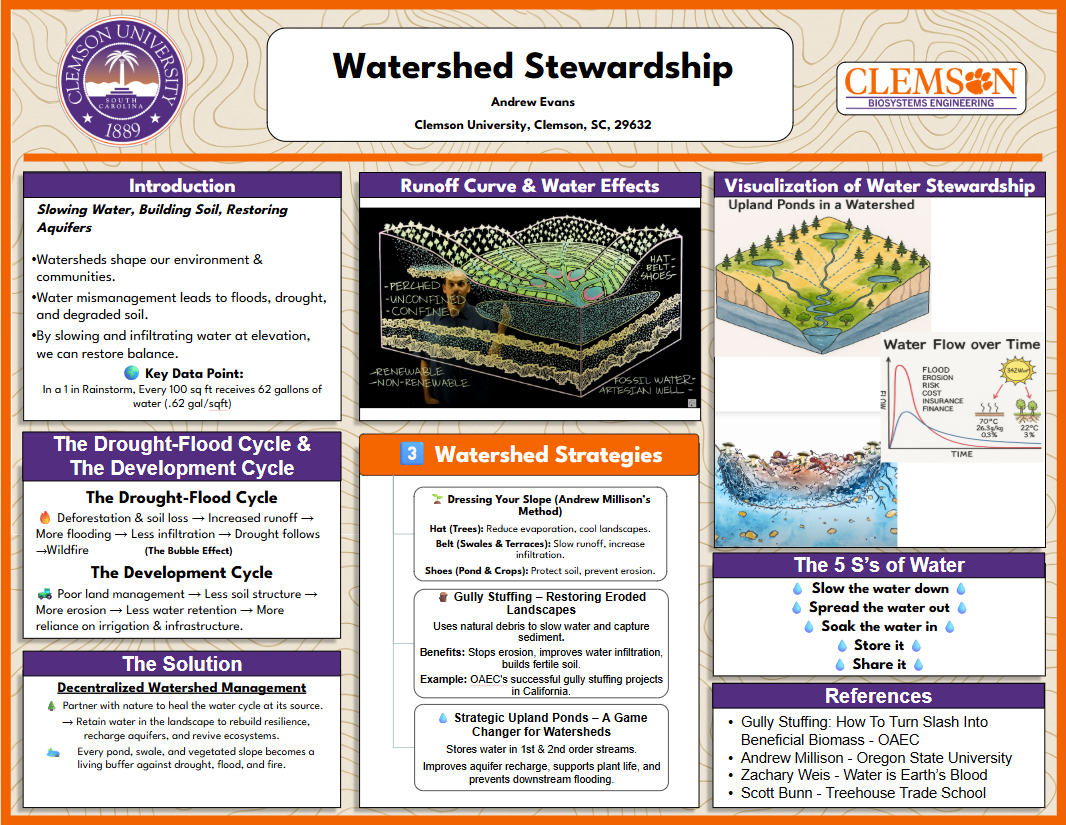
Invitation to the President
The club's letter to Interim President Dr. Robert H. Jones, inviting him to the March 12 guest lecture by Dr. Steve Jones of Meanders River Restoration.
Open the PDF →Research & reference
Technical context, academic papers and planning history behind the Hunnicutt work.
City of Clemson: Green Infrastructure Workshop
Workshop 3 of the city's green infrastructure mapping series, February 2026. It names the food forest as a possible monarch pollinator corridor node.
Open the PDF →Restoring Hunnicutt Creek, Calvin Sawyer, 2018
Longitudinal results from Clemson's earlier campus restoration project, by Calvin Sawyer, Jeremy Pike, Rebeckah Hollowell and Charles Privette.
Open the PDF →Clemson Riparian Corridor Master Plan, 2006
The university's 75-page master plan for campus riparian corridors, including Hunnicutt Creek.
Open the PDF →BEHI: Bank Erosion Hazard Index
The reference for the field tool the CI uses to score bank erosion at Reach 1.
Open the PDF →See all research & reference
Aiken Downtown Stormwater: Case Study
The City of Aiken's Sand River Headwaters project: rain gardens, bioswales, porous pavement and cisterns retrofitted into downtown streets.
Open the PDF →Aiken Downtown Stormwater: Project Reference
The companion deck for the Aiken project, including the lesson that treating only 0.4% of the watershed limited the gains.
Open the PDF →The Digital Twin Database
A catalog of the species at Hunnicutt, with canopy layer, guild roles, nitrogen fixer status, mycorrhizal type, host species, edible parts and watershed function for each. The club built it in Spring 2026 and checked it against the NC State Extension Plant Toolbox. It is the base for the food forest digital twin.
It comes as an Excel workbook with four sheets: Species Database, Hunnicutt Field Instances, Field Dropdowns, and Reference Links.
Questions about the work?
Most of our documents are open above. For anything not listed, or to talk about the research, write to us, or ask in public on the cork board.